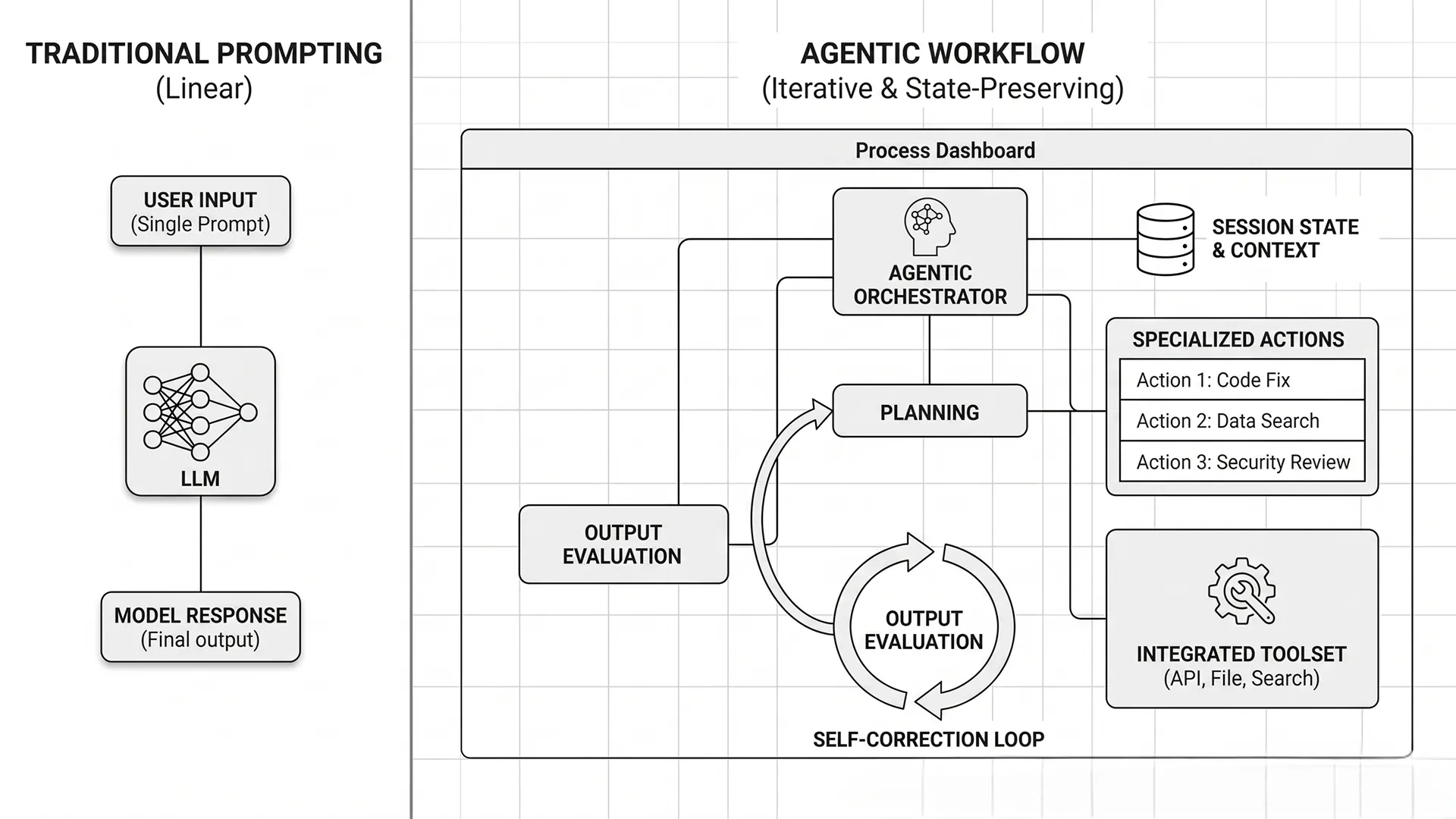
The landscape of artificial intelligence engineering has fundamentally shifted. Over the past few years, the industry moved rapidly from marveling at zero-shot text generation to demanding autonomous, multi-step execution. Building a wrapper around an API endpoint is no longer sufficient. Today's engineering challenge lies in designing agentic workflows—systems where language models actively plan, execute, and evaluate tasks within a production environment.
Transitioning from simple prompting to a resilient agent architecture requires a deep understanding of state management, tool orchestration, and system observability.
The Limitations of Basic Prompting
A standard prompt-response architecture is inherently stateless and linear. While effective for simple transformations or summarization, it breaks down when faced with complex, multi-step objectives.
When a system relies solely on large context windows to maintain operational logic, it becomes vulnerable to hallucination and context degradation. The model loses track of early instructions as the prompt grows. Furthermore, a single LLM call cannot dynamically interact with external environments, adapt to mid-task failures, or verify its own outputs against deterministic business rules. To solve these problems, developers must transition to an agentic architecture.
Anatomy of a Production-Grade Agentic System
A robust agentic workflow is not a single script; it is a distributed system of specialized components working in tandem.
Orchestration and Routing
Instead of feeding a monolithic prompt into a single model, production systems utilize an orchestrator or router. This controller evaluates the incoming request and delegates sub-tasks to specialized micro-agents. For example, in a unified workspace application handling code intelligence and task management, one agent might be explicitly tuned for code analysis while another handles natural language query parsing. This separation of concerns improves accuracy, reduces token consumption, and allows developers to swap underlying models based on task complexity.
State and Memory Management
Agents require a robust memory architecture to maintain context across prolonged interactions. This is generally divided into short-term memory (the current session's state) and long-term memory (historical data and user preferences).
Implementing a flexible, document-based architecture using MongoDB allows for the rapid indexing of conversation histories and execution logs. By structuring memory explicitly in a database rather than relying entirely on the LLM's context window, the system can dynamically retrieve only the most relevant context using vector search and standard querying, keeping token limits manageable and responses highly relevant.
Tool Calling and Execution
The defining feature of an agent is its ability to take action. This requires strict schemas for tool calling. The LLM must output structured data (typically JSON) that maps directly to internal APIs or external services.
If an agent is designed to parse and rewrite data—such as in an automated ATS resume evaluation engine—the execution layer must validate the LLM's output structure before applying it to the database. If the output is malformed, the execution layer triggers a retry loop, feeding the error back to the LLM for self-correction without user intervention.
Development and Deployment Tooling
The tooling ecosystem for AI engineering has matured, allowing for much faster iteration cycles.
When developing the intricate logic required for these loops, advanced IDE environments like Cursor Composer 2.0 have become invaluable. They allow engineers to rapidly prototype agentic behavior, trace logic execution, and refactor code interactively. This agentic coding approach mirrors the very systems being built, drastically cutting down the time it takes to validate complex LLM orchestration.
However, moving these workflows to production introduces the need for strict Continuous Integration/Continuous Deployment (CI/CD) pipelines specifically tailored for AI. Code changes might break prompts, and model updates might change output formats. Automated testing must include LLM-as-a-judge evaluations to ensure response quality remains consistent across deployments.
Real-World Implementation: Observability and Fallbacks
A production agent will eventually fail. APIs timeout, rate limits are hit, and models occasionally produce nonsensical logic.
Observability is non-negotiable. Every token generated, tool called, and latency metric must be logged. When building enterprise-grade tools, implementing graceful fallbacks is critical. If an advanced model like GPT-4o or Claude 3.5 Sonnet times out during a complex reasoning task, the system should automatically degrade gracefully, perhaps falling back to a faster, cheaper model for a simpler response, or alerting a human-in-the-loop.
The Path Forward
Architecting agentic workflows requires a paradigm shift from traditional software engineering. It blends probabilistic outputs with deterministic system design. By focusing on robust orchestration, scalable memory integration, and comprehensive observability, engineers can build AI systems that do more than just converse—they execute, adapt, and drive tangible product value.